admin
admin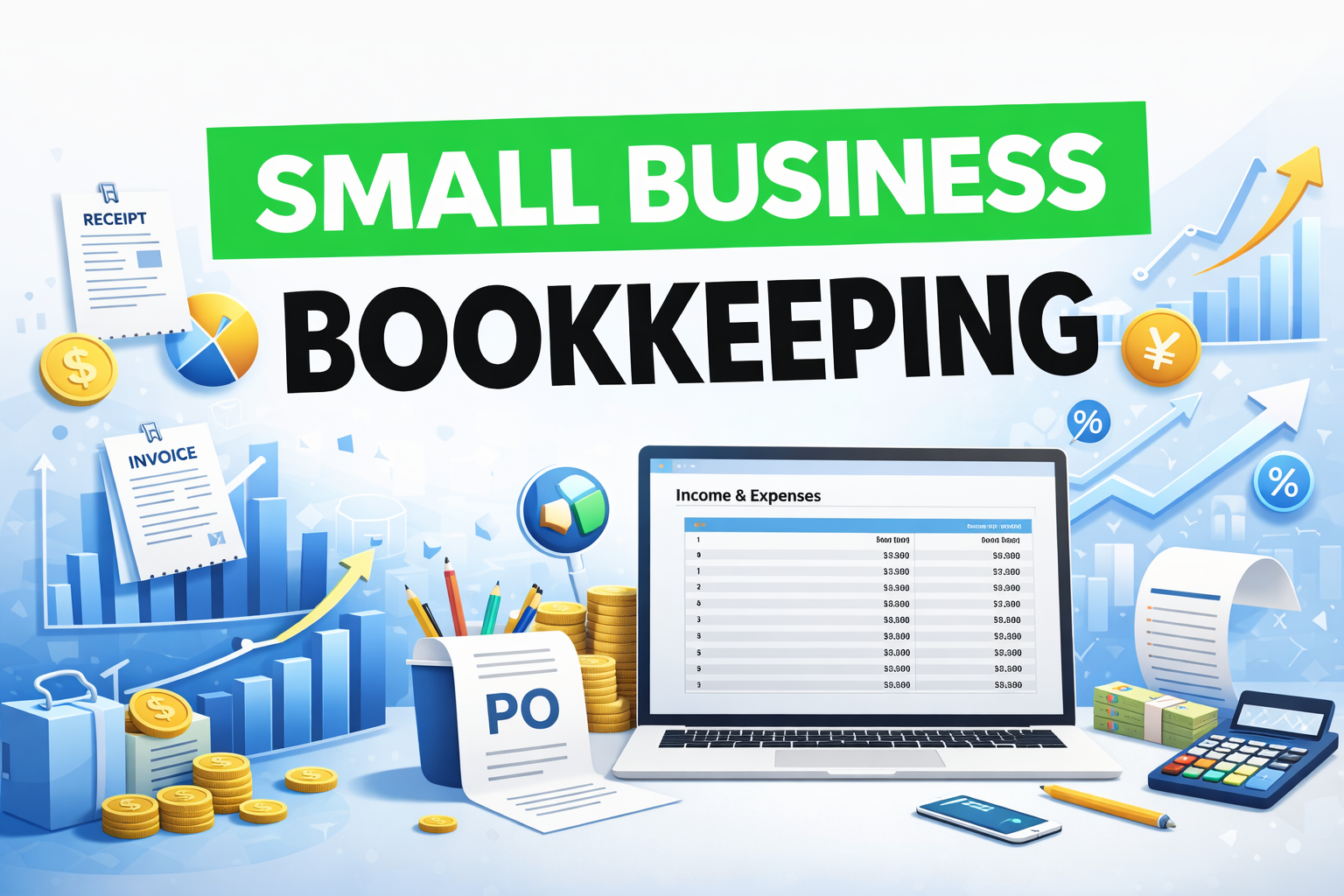
In Part 1, we discussed why bookkeeping matters, how small businesses can get started using free tools, and why having a separate business bank account is critical.
Now, in Part 2, we focus on the how.
Bookkeeping is not rocket science. It is a simple, repeatable process that any small business owner, freelancer, or online seller can follow. Once you understand the flow, it becomes a habit – not a headache.
In this article, we will clearly explain:
🛒 The purchase process (PO & GRN)
🧾 Invoices and why they matter
💰 How to record income and expenses
📊 How to create a final statement
🔍 How to analyze results for decisions
🧮 Basics of assets, liabilities, and equity
By the end, you’ll have a simple bookkeeping system you can use confidently without overwhelm.
🔄 The Core Bookkeeping Flow: Purchases, Sales, Records & Reports
Think of bookkeeping like a money river:
⬆️💵Money flows in → income
⬇️💸Money flows out → expenses
📊Reports are the checkpoints that show where you stand
Every small business follows this basic cycle:
Purchases → Sales → Records → Reports → Decisions
Let’s break it down step by step.
🛒 01. Purchases: The PO / GRN Process (Buy Smart, Track Everything)
Whenever you buy stock, raw materials, or services, you should follow a simple PO and GRN system. This keeps your purchases controlled and documented.
📝 Step 1: Create a Purchase Order (PO)
A Purchase Order (PO) is a document created before buying from a supplier.
It includes:
👤Supplier name
🗂️Items and quantities
💰Price and total value
📝Payment terms (example: “Pay in 30 days”)
You can create a PO using:
Free bookkeeping software (Wave, Zoho Books)
Google Sheets or Excel
📌 Why PO matters
Prevents overbuying
Protects against supplier disputes
Helps plan cash and inventory
👉 A PO is simply official approval to buy.
📦 Step 2: Receive Goods with a GRN
A Goods Received Note (GRN) is prepared when goods arrive.
Check:
Quantity received
Item condition
Match with the PO
You can:
Fill a simple GRN form
Or take a photo of the delivery note and store it
📌 Why GRN matters
Confirms what you actually received
Stops paying for missing or damaged goods
Improves inventory accuracy
Simple flow:
PO → GRN → Supplier Invoice
💡 Pro Tip: Zoho Books and similar tools auto-generate POs and GRNs.
🧾 Invoices: What They Are and Why You Need Them
An invoice is your official request for payment.
It is not just a receipt — it is legal proof of a sale.
Every sale should have an invoice.
📄 What an Invoice Includes
Your business details
Customer details
Product or service description
Quantity and price
Total amount due
Due date and payment terms
🔍 Why Invoices Are Critical
Create proper income records
Speed up customer payments
Protect you in disputes
Required for taxes and audits
👉 No invoice = delayed payments = cash flow problems.
Example:
Sold T-shirts worth $500
Invoice: 5 × $100 = $500 due by Jan 30
Record income when payment is received.
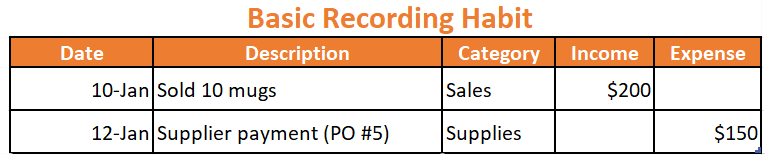
💰 03. Recording Income & Expenses (The Daily Habit)
This is the heart of bookkeeping — consistency matters more than complexity.
| Record | Categorize Income Like |
|---|---|
| Sales from invoices | Product Sales |
| Cash payments | Service Income |
| Online transfers | Online Orders |
| Record | Categorize Expenses Like |
|---|---|
| Supplier payments (POs) | Supplies / Stock |
| Rent & Utilities | Rent / Electricity / Water |
| Marketing & Ads | Advertising / Promotions |
| Transport & Fuel | Transport / Delivery |
| Office Supplies | Office / Operating Costs |

🧮 04. Assets, Liabilities & Equity (The Simple Equation)
Everything in bookkeeping comes back to one basic formula:
Assets = Liabilities + Equity
🟢 Assets – What the Business Owns
Cash and bank balance
Inventory (stock)
Equipment and tools
Unpaid customer invoices
🔴 Liabilities – What the Business Owes
Supplier bills
Loans and overdrafts
Unpaid taxes
🔵 Equity – Owner’s Real Value
Owner investment
Retained profits
📌 Why this matters
This separation shows the true financial health of the business — not just cash on hand.
📊 05. Creating the Final Statement (Profit & Loss)
At month-end, generate your Profit & Loss (P&L) Statement from your software.
📄 What P&L Shows
Total Income – Total Expenses = Net Profit (or Loss)
Example:
January P&L
Income: $5,000
Expenses: $3,500
Rent: $1,000
Supplies: $1,200
Marketing: $800
Other: $500
Net Profit: $1,500
📌 Always match this with your bank balance and fix errors early.
🔍 06. Analyzing the Final Statement (Turn Numbers into Action)
Numbers are useless unless you analyze them.
Ask these key questions:
✅ Profit Check
Is profit positive or negative?
Which expense is the highest?
📈 Trend Analysis
Sales growing but profit flat?
Expenses increasing faster than income?
📈 Trend Analysis
Sales growing but profit flat?
Expenses increasing faster than income?
🚀 Growth Signals
Healthy profits and equity?
Safe to reinvest in stock, ads, or tools?
Action example:
P&L shows $1,000 spent on ads with poor results → Pause campaigns → Save $500 next month.
💬 Want to Learn More?
This guide covers the core bookkeeping process every small business should understand.
If you’d like us to explain more topics such as:
Real-life bookkeeping examples
Common bookkeeping mistakes
Inventory tracking in detail
Tax basics for small businesses
Or how to set up bookkeeping from zero
👉 Leave a comment below and tell us what you want to learn next.
We’ll cover it in the next part of this series.