admin
admin
Most people believe that to succeed in sales, you need a great product or a high-quality service.
But if you really look at successful sellers, you’ll notice something different.
Some of them sell average products… yet they close deals consistently. Others have great products… but struggle to make a single sale.
So what’s the difference?
The answer is simple.
👉 It’s not the product. It’s the strategy, mindset, and communication behind the sale.
In this article, I’m going to walk you through five powerful sales strategies that can completely change the way you approach selling. These are practical, real-world ideas you can apply immediately – even if you feel like what you’re offering isn’t strong enough.
🔥 Strategy 1: Product Knowledge and Conviction
Everything in sales starts from one place – your belief.
If you don’t understand what you’re selling, or worse, if you don’t believe in it, your customer will feel that instantly.
Think about this for a moment.
When a customer asks you a question, are you answering with confidence? Or are you just repeating what you heard from somewhere else?
There is a big difference.
When you truly understand your product, you don’t just talk about features. You explain how it helps, why it matters, and who it’s for. That creates trust.
And trust is what leads to sales.
But knowledge alone is not enough. You also need conviction.
Conviction means you genuinely believe that your product or service can help someone. That belief reflects in your tone, your body language, and even the way you handle objections.
If you are unsure, the customer becomes unsure.
So before trying to improve your sales skills, take a step back and ask yourself:
- Do I really understand what I’m selling?
- Do I personally believe in its value?
If the answer is not strong, that’s the first thing you need to fix.
Because every successful sale begins with your own belief.
💡 Real Example: How Steve Jobs Sold the iPhone Without Selling Features
Let’s look at one of the most powerful sales moments in history.
When Apple introduced the first iPhone, Steve Jobs didn’t walk on stage and start talking about specifications.
He didn’t say:
❌ “This phone has advanced hardware and technical features”
Instead, he did something completely different.
He built curiosity.
He said:
“Today, Apple is going to reinvent the phone.”
That single line changed everything.
The audience leaned in. Attention increased. Curiosity exploded.

🧠 Strategy 2: Sales is Mostly Mindset
Many people spend time learning scripts, techniques, and closing tricks. While those are useful, they are not the main factor. In reality, sales is largely about your mindset.
You might have heard customers say, “I don’t have money.” Most beginners take this as a final answer, but experienced salespeople think differently.
They understand that in most cases, it’s not about money. It’s about how the customer perceives value. If something feels important enough, people will always find a way.
So instead of thinking, “This customer can’t afford it,” a better question is:
👉 “Have I clearly shown the value?”
This shift in thinking changes everything.
You stop begging for a sale and start guiding the customer toward a decision.
You become more confident, calmer, and more focused, and interestingly, customers respond better to that energy.
At the end of the day, people don’t just buy products – they buy confidence, clarity, and certainty.
And all of that starts from your mindset.

💡 Mindset Shift
Instead of thinking:
❌ “I hope they buy”
Start thinking:
✅ “I’m helping them make a smart decision”
✅ “Value is not clear yet”
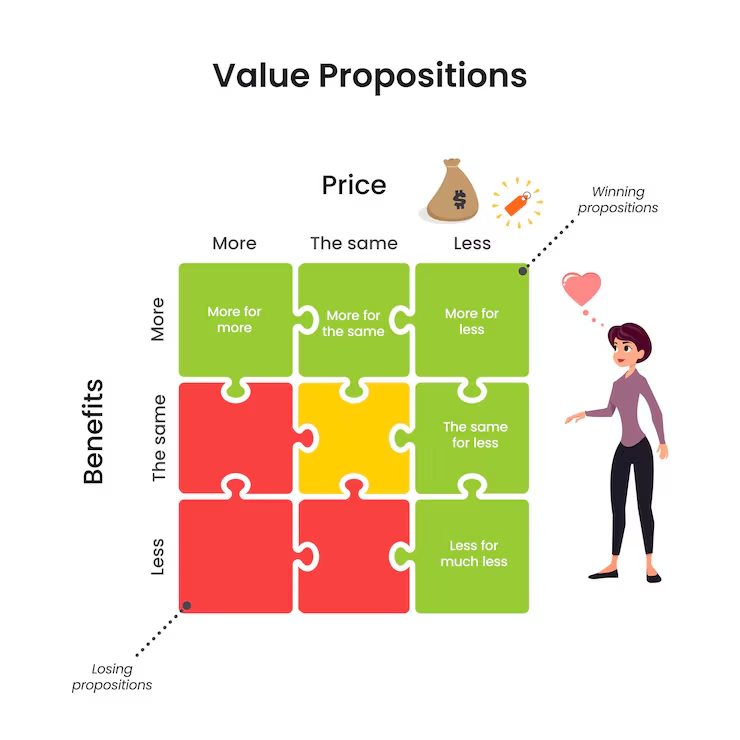
💎 Strategy 3: Build a Strong Value Proposition
If there is one skill that separates average sellers from great ones, it is the ability to communicate value.
Most people talk too much about the product.
But customers don’t care about the product itself. They care about what it does for them. So your job is to make that value crystal clear.
There are two important angles you need to cover when explaining value:
- Relevance – why this matters to the customer
- Impact – what difference it will make in their life or business
Let’s make this simple.
Imagine you are selling a software tool.
If you just explain features, the customer may listen… but not act.
But if you say, “This can save you 2–3 hours of work every day and reduce manual errors,” now it becomes real.
Now it feels useful.
Another powerful way to communicate value is by showing what happens if they don’t take action.
Not in a negative or aggressive way, but in a logical way.
Help them see:
- What they might lose
- What problems will continue
- What opportunities they are missing
When both sides are clear — the benefit of buying and the cost of not buying — decision-making becomes much easier.
🎯 Strategy 4: Focus on the Right Customers
One of the biggest reasons people struggle in sales is because they spend too much time on the wrong customers.
Not every lead is ready to buy.
Some people are just curious. Some are comparing options. Some are not interested at all. If you treat all of them the same, you waste time and energy.
Instead, you need to identify who is most likely to convert.
A simple way to think about this is:
- Hot leads → ready to buy
- Warm leads → interested but need clarity
- Cold leads → not ready
The mistake most people make is focusing too much on cold leads. They keep calling, messaging, and trying to convince people who are not ready, but smart sellers do the opposite. They prioritize the people who are already interested and close to making a decision.
This doesn’t mean you ignore others. It just means you manage your time wisely.
When you focus on the right customers, your conversion rate naturally improves.
And more importantly, your effort starts giving better results.

⚡ Strategy 5: Communicate Clearly and Reduce Friction
Sometimes, sales don’t fail because of the product or the customer. They fail because of confusion. If your explanation is too long, too complex, or unclear, the customer loses interest.
In today’s world, attention is limited.
So your communication needs to be simple and direct.
Instead of explaining everything, focus on what matters most.
Make it easy for the customer to understand:
- What it is
- How it helps
- Why they should care
When your message is clear, decisions become faster. You don’t need long conversations or repeated follow-ups. Clarity reduces friction and less friction means more conversions.