admin
admin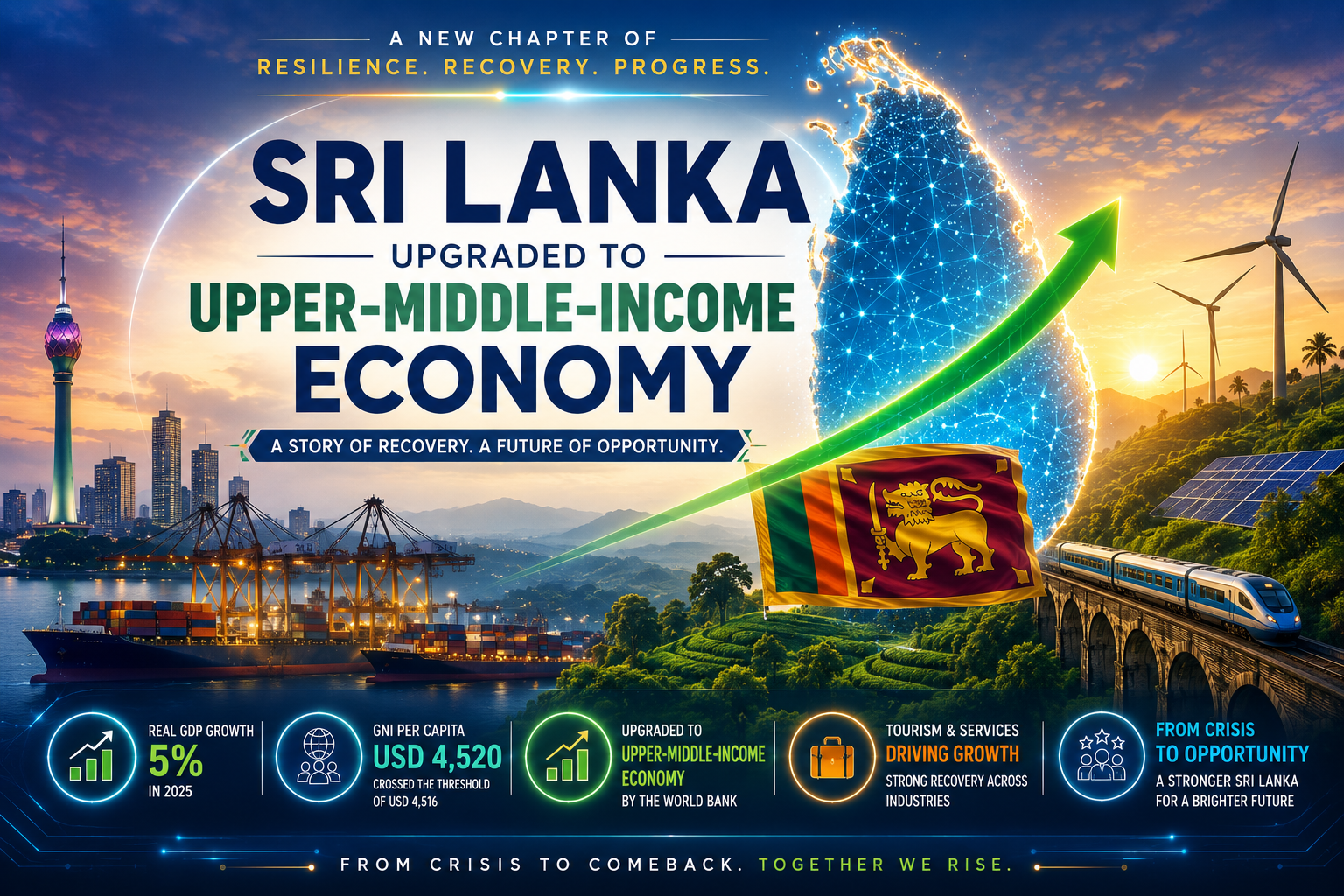
Three years ago, few would have imagined that Sri Lanka would once again be making positive economic headlines around the world.
In 2022, the nation faced one of the most severe economic crises in its history. Long queues for fuel, shortages of essential goods, soaring inflation, declining foreign reserves, and widespread uncertainty pushed the country to the brink of economic collapse. Many questioned how long it would take Sri Lanka to recover.
Fast forward to 2026, and the narrative has changed significantly.
According to the latest World Bank income classification update, Sri Lanka has officially been upgraded to an Upper-Middle-Income Economy, marking a major milestone in the country’s recovery journey. While the achievement may appear to be a technical economic classification, it tells a much deeper story—one of resilience, determination, reform, and recovery.
For Sri Lankans at home and abroad, this recognition represents hope and a reminder that even after the darkest periods, nations can rebuild and move forward.
A Nation That Refused to Give Up
The economic crisis of 2022 was a defining moment in Sri Lanka’s modern history.
The country experienced:
- Severe foreign exchange shortages
- Fuel and gas scarcity
- Rising inflation
- Currency depreciation
- Reduced investor confidence
- Declining economic activity
- Increased cost of living
Businesses struggled to operate. Families faced unprecedented financial pressure. Many industries slowed dramatically as the economy entered a period of instability.
Yet amid the challenges, Sri Lanka demonstrated something powerful—resilience.
Government reforms, support from international partners, fiscal adjustments, debt restructuring efforts, tourism recovery, export performance, and the determination of millions of citizens contributed to a gradual economic turnaround.
Today, that resilience has been recognized on the global stage
What Does Upper-Middle-Income Economy Mean?
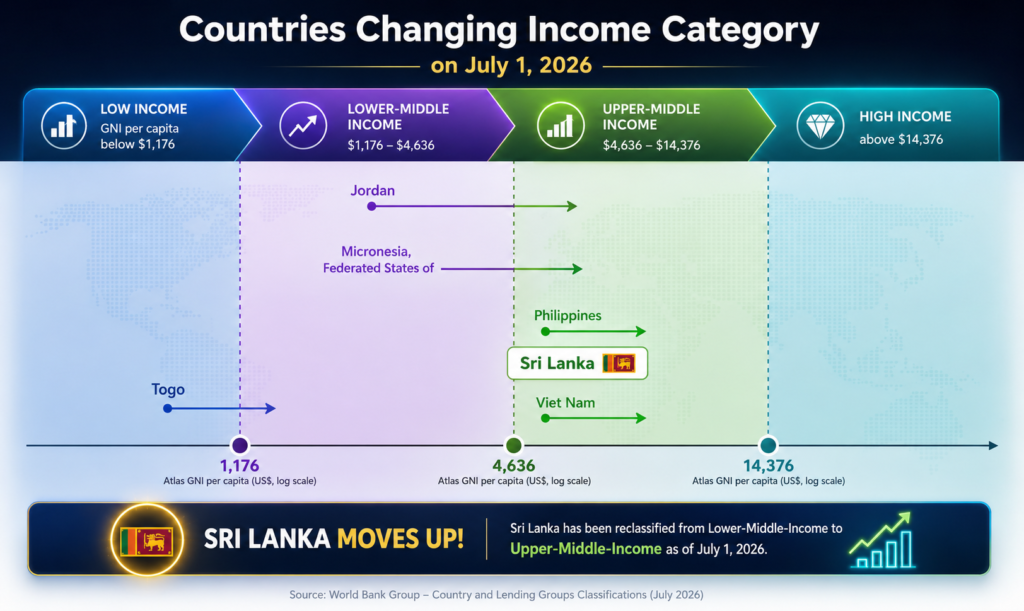
The World Bank classifies countries into four income groups based on Gross National Income (GNI) per capita using the Atlas Method.
The categories are:
- Low-Income Economies
- Lower-Middle-Income Economies
- Upper-Middle-Income Economies
- High-Income Economies
These classifications are updated annually and help governments, investors, economists, and international organizations assess a country’s economic position.
For the latest classification period, the threshold for Upper-Middle-Income status was approximately USD 4,516 GNI per capita.
Sri Lanka crossed this benchmark with an estimated GNI per capita of around USD 4,520, narrowly but successfully moving into the Upper-Middle-Income category.
While the margin was small, the significance is enormous.
Crossing this threshold demonstrates that Sri Lanka’s economy has regained momentum after one of the most challenging periods in its history.
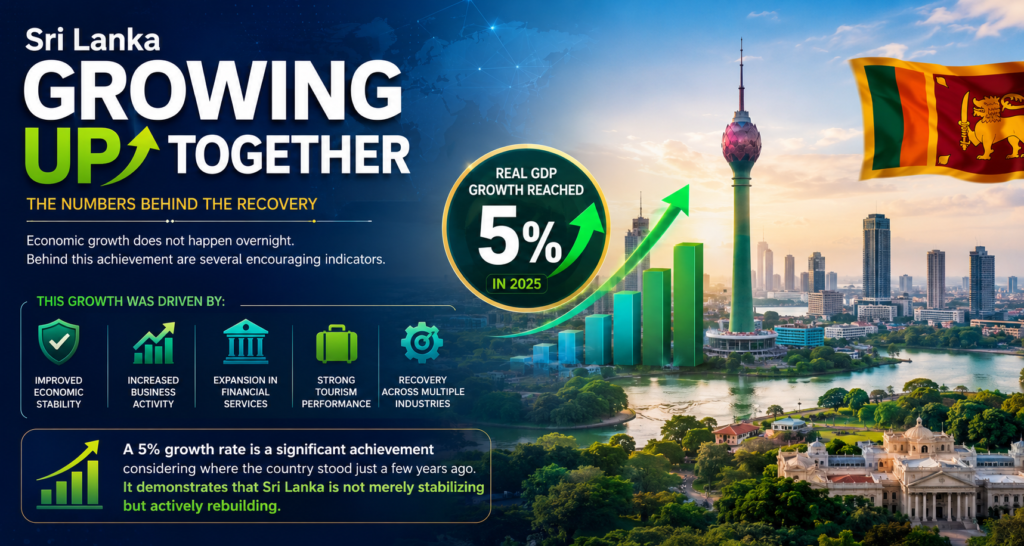
The Numbers Behind the Recovery
Economic growth does not happen overnight.
Behind this achievement are several encouraging indicators.
Real GDP Growth Reached 5%
One of the most important signals of recovery is economic growth.
According to recent data, Sri Lanka’s real GDP grew by approximately 5% in 2025.
This growth was driven by:
- Improved economic stability
- Increased business activity
- Expansion in financial services
- Strong tourism performance
- Recovery across multiple industries
A 5% growth rate is a significant achievement considering where the country stood just a few years ago.
It demonstrates that Sri Lanka is not merely stabilizing but actively rebuilding.
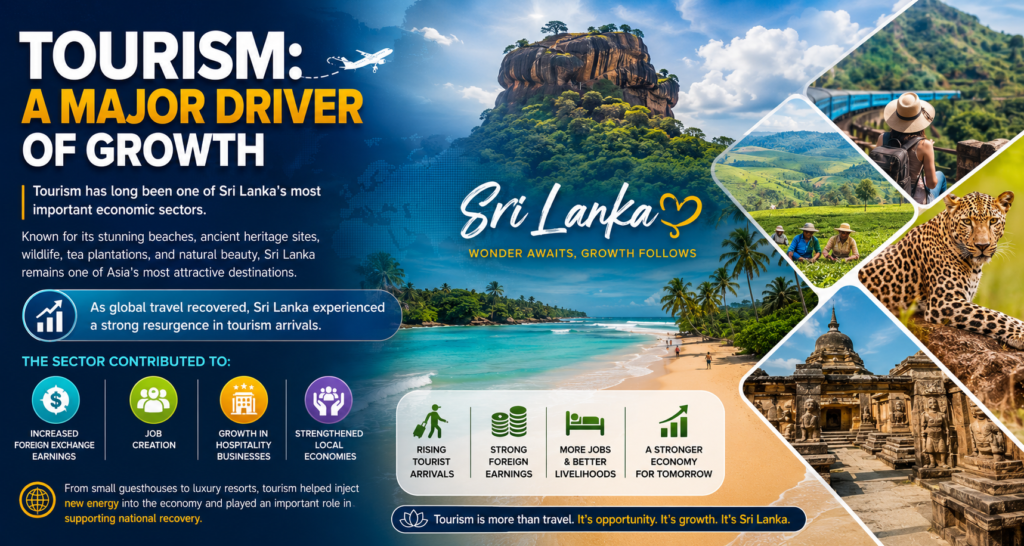
Tourism: A Major Driver of Growth
Tourism has long been one of Sri Lanka’s most important economic sectors.
Known for its stunning beaches, ancient heritage sites, wildlife, tea plantations, and natural beauty, Sri Lanka remains one of Asia’s most attractive destinations.
As global travel recovered, Sri Lanka experienced a strong resurgence in tourism arrivals.
The sector contributed to:
- Increased foreign exchange earnings
- Job creation
- Growth in hospitality businesses
- Strengthened local economies
From small guesthouses to luxury resorts, tourism helped inject new energy into the economy and played an important role in supporting national recovery.
Why This Classification Matters❓
Some may wonder why a World Bank classification is important.
The answer lies in perception, confidence, and opportunity.
1. Increased Investor Confidence
Investors closely monitor economic indicators when deciding where to allocate capital.
Being recognized as an Upper-Middle-Income Economy can strengthen confidence in Sri Lanka’s long-term prospects.
This can attract:
- Foreign direct investment
- Infrastructure development
- International partnerships
- Business expansion opportunities
More investment often translates into more jobs and economic growth.
2. Opportunities for Local Entrepreneurs
Entrepreneurs are often among the biggest beneficiaries of economic recovery.
A stronger economy creates opportunities for:
- Startups
- Small businesses
- Online businesses
- Exporters
- Technology companies
- Service providers
As consumer confidence improves and investment increases, businesses gain more opportunities to grow and innovate.
3. Enhanced Global Reputation
The classification improves Sri Lanka’s standing in the international community.
It demonstrates that the country has made meaningful progress despite recent challenges.
For international organizations, development partners, and multinational corporations, this sends a positive signal about Sri Lanka’s economic trajectory.
The Road Toward High-Income Status
Sri Lanka’s journey toward sustainable prosperity
Innovation
Technology and innovation will play a critical role in future economic growth. Investing in digital transformation can increase productivity and competitiveness.
Education
A skilled workforce is essential for long-term prosperity. Investments in education and workforce development can help prepare future generations for emerging industries.
Exports
Expanding export markets can strengthen foreign exchange earnings and support sustainable growth.
Entrepreneurship
Encouraging innovation and supporting small businesses can create jobs and stimulate economic activity.
Good Governance
Economic progress is most sustainable when supported by transparency, accountability, and sound policymaking.
Sri Lanka’s Next Chapter Begins Now
Economic recovery is not a single event.
It is a continuous journey.
Sri Lanka’s upgrade to Upper-Middle-Income Economy status is a milestone that reflects determination, resilience, and progress.
It is evidence that a country can recover from adversity when people, businesses, and institutions work toward a common goal.
The road ahead will require continued effort, innovation, and smart economic management. Yet this achievement offers something invaluable—a reason to believe in the future.
Three years after standing at the edge of economic collapse, Sri Lanka is once again moving forward.
Not because every challenge has been solved.
But because the nation proved it could rise, rebuild, and recover.
And perhaps that is the most powerful story of all.